On a disconcertingly warm October afternoon, Hannah Hart wanders around the West Village, sharing her emotions in real time with thousands of her fans. It’s the release day for her new memoir, Buffering: Unshared Tales of a Life Fully Loaded, and she snapchats breathlessly about her nerves and excitement from the sidewalks of New York.
By the time she bounds into Julius, New York City’s oldest gay bar, it’s sparsely populated with a few older, gray-bearded guys nursing beers and poring over the paper. She stands out. Her snap successfully posted, Hart is all smiles, overflowing with seemingly limitless energy: a five-foot-four ball of blonde sunshine. She’s wearing a dressy, androgynous black button-up shirt, which she’d chosen (according to a snap she’d posted earlier that day) because she was feeling vulnerable.
“This is the coolest spot for an interview ever,” she says, sliding into a booth at the back of the bar, which is dimly lit and bedecked with the requisite rainbow flags. “Mind if I Snapchat this?”
Hart, a self-described “internet demigod,” soared to viral fame in 2011 when she made a video of getting drunk while cooking to cheer up a friend. The one-off YouTube upload has since evolved into Hart’s most well-known series: My Drunk Kitchen, which inspired the bestselling 2014 book of the same name. She’s spent the past five years taking the most beloved tenets from her early viral videos — silliness, unrelenting positivity, self-love, and support for others — and building them into the Harto (as she’s known on her channels) mega-brand. Today, her main YouTube channel has 2.5 million followers, while her Twitter and Instagram have just over a million each. In addition to writing two books, she’s starred in two straight-to-VOD movies, hosted dozens of live #NoFilterShows, and built My Drunk Kitchen into an empire.
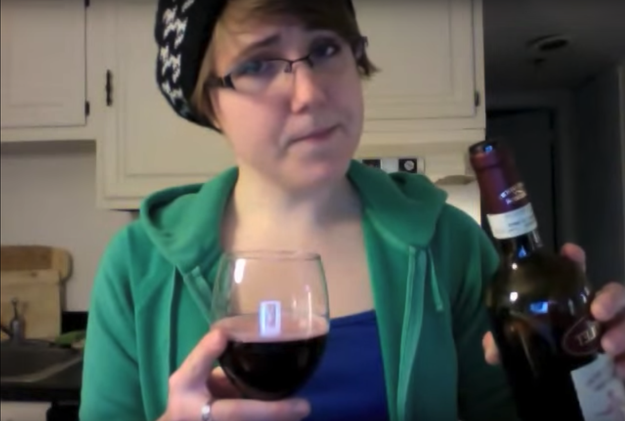
A still from a 2011 episode of My Drunk Kitchen.
MyHarto / YouTube / Via youtube.com
But for over a year of My Drunk Kitchen's early success, Hart's followers had no idea about an important but invisible part of her identity. In 2012, when she was feeling exhausted by the entertainment world and considered leaving YouTube for good, she decided to get over the “self-hating gay” phase of her life by coming out publicly (in a video, of course — the first of many coming out “chapters”), which reinvigorated her commitment to the form. Suddenly, she was no longer just an accidental YouTuber with a punny cooking show. She was a role model for the young LGBT people who subscribed to her channels, myharto and yourharto, by the hundreds of thousands.
Though most people born before 1980 don’t know her name, Hart has millions of millennial followers who attend her meet and greets, write her fan mail, and generally obsess over her every move. Like other social media stars, Hart’s brand is all about relatability: She fools around with charcoal face masks and gets drunk with her friends. She is aspirational — undeniably famous by internet standards; wealthy; a video-producing, book-writing jill-of-all-trades — but also, paradoxically, positions herself as a regular old person, just like everybody else. And that regularity, paired with the constant stream of hyper-personal content that’s delivered straight into the feeds of her followers, is part of her enormous appeal.
To Hart’s fans, she isn’t an untouchable megastar, preserved in a gold-plated bubble of stardom, but a friend and an ally who cares. They say she’s given them the courage to come out to their families; they say she’s helped them through life’s heartaches, whether the death of a family member or the latest round of chemo; they say she gives them the strength to just keep moving forward. “The older I get, it’s like, I’m just gonna cry my way through every meet and greet,” Hart tells me, laughing, sounding at once humbled and astonished.
Now, on the eve of her 30th birthday, Hannah Hart is still playing herself: her nice, vulnerable, earnest, positive self. She has no intention of slowing down her YouTube output anytime soon. Meanwhile, she’s prepping for the release of her new Food Network show and someday wants to become the face of lesbian rom-coms. After spending years wrestling with internalized homophobia, then finding her footing in a constantly shifting digital media landscape, all Hart wants is to keep flooding the internet with her goofy, punny, uplifting brand of self-acceptance — and to show young LGBT people positive representations of queer life.
Her brand, in a word, is niceness. And in these loud, scary, cynical times, niceness doesn’t often get a lot of traction. Her popularity is about to be tested outside of the youth-oriented corners of the internet that already love her. In the process, can Hannah Hart make niceness cool again?
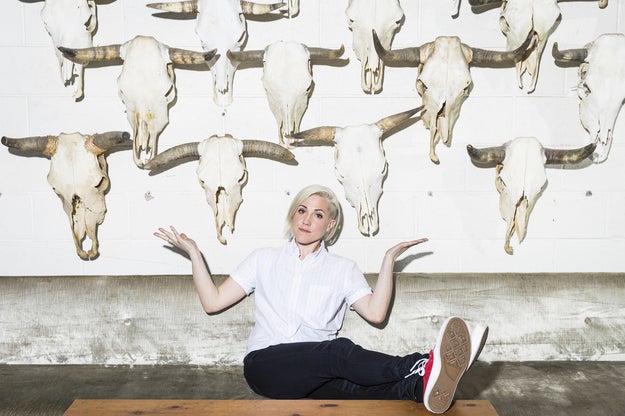
Hannah Hart at The Forge studio in Los Angeles on Oct. 25, 2016.
Emily Berl for BuzzFeed News
Hart doesn’t spend a lot of time in gay bars. Before moving to LA, she’d sometimes go to Cubbyhole, in the West Village, which is as tiny as its name suggests, but is unequivocally the best lesbian bar in New York. (Not like we have that many options.)
“I don’t go to gay bars because I live in pretty progressive cities,” she says. “But if you ever want to cry and think about America, you should watch Small Town Gay Bar. I used to do this thing called Harto Movie Night, where we would all get together and watch movies — and I was like okay guys, Small Town Gay Bar, gonna be fun, whee! I wept. It was about people in all these cities in America in the middle of nowhere that are really desperate. Really funny livestream! People were being like, ‘I’m crying!’” and I was like ‘Me too, me too.’”
Hart, like so many gay people before her, spent years struggling to come to terms with her sexuality. She grew up in Burlingame, California, where she was raised to believe that homosexuality is a sin. Her father, a Jehovah’s witness, still thinks that being gay is a perversion; the two of them no longer speak.
For a long time, Hart couldn’t bring herself to use the word “queer.” “I used to say, like, ‘I hate using the word, I’m not queer cause queer means weird.’ And now I’m like, ‘The queer community, dada dada dada dada’ —” she fleshes out her hypothetical sentences this way a lot — “I’m totally fine with it.”
In Buffering, Hart details the account of her first relationship with a woman, back in college, which will sound familiar to a lot of other lesbians: She and her girlfriend (although they didn’t think of each other as girlfriends, exactly) were constantly all over each other and had plenty of sex, but insisted that they weren’t gay. Now, almost 10 years later, she’s a beacon for others wrestling with the same demons. But that wasn’t always the plan.
Unlike other YouTubers, Hart didn’t arrive on the platform with ambitions to become an internet personality or entertainer. Her first upload in 2011 — titled “Butter Yo Shit,” which would become the first installment of My Drunk Kitchen — was thrown together to cheer up a friend in the throes of depression who was living across the country. A year after launching her channel, Hart became a paid YouTube partner, quitting her day job as a proofreader at a translation firm and moving from New York to Los Angeles.
harto / Instagram / Via Instagram: @harto
In her memoir, she details how difficult it was to navigate the isolating world of fast fame: It was hard to know whether people were interested in her as a person, or whether they simply wanted to use her to fuel their own ambitions.
“I was a much less trusting person when I started out,” she says. “And I think it’s because I didn’t trust myself to make good decisions about my friendships.”
“I didn’t think of myself as an entertainer,” she adds. “It was my second year — my second year of anything. It was a lot to learn really fast.” Her friends and frequent collaborators, Mamrie Hart and Grace Helbig, came out of traditional theater and improv backgrounds; for them, YouTube was a stepping stone toward other opportunities to act and write. Hannah, meanwhile, was still figuring out what she wanted — for her brand and for herself.
As 2012 drew to a close, she was feeling exhausted by the superficiality and nepotism of Los Angeles. Plus, she’d been making videos for nearly two years, but her fast-growing audience didn’t know she was gay. Her brand was all about self-love, but she hadn’t yet publicly embraced this important part of her identity. Inspired by Anderson Cooper’s recent coming out, she uploaded one of her own: 11 minutes of pure heart to heart. She’d found a new purpose in promoting and celebrating LGBT visibility. Almost immediately, Hart was en route to becoming one of the internet’s biggest gay icons.
For Hart, it’s a point of pride that in the film Dirty 30 — which was simultaneously released in select theaters and to VOD in September — her character is openly gay and it’s “just chill.”She plays Charlie, who teams up with Grace Helbig's Evie to throw their best friend Kate (Mamrie Hart) a 30th birthday party. All three stars also executive-produced the project, which was made on a micro-budget, like their first feature film together, 2014’s Camp Takota. Neither film was widely reviewed, and audience consensus for both was generally poor, but they were financial successes. According to RockStream, which produced Camp Takota, the movie was profitable from day one. Preteens lapped the films up, and the Tumblr crowd was thrilled with their queer representation, particularly in Dirty 30.
"I wanna make like, fifty gay rom-coms with adorable little plots. Wouldn’t that be nice? Just a little joy?”
Since mainstream media has a bad habit of killing off lesbian characters, Hart hoped her role in Dirty 30 could provide a counter-narrative to near-constant depictions of gay suffering. “Entertainment is one of the best ways to undercover-message that everything will be okay, and that it gets better — when we show more happy, healthy relationships,” she says. “If I was a little like baby gay in Oklahoma somewhere, and fucking Lexa dies” — last March, a lesbian character named Lexa was killed off on The 100, which led fans to outrage and action — “that would…that is DEVASTATING. Because then you’re like, maybe I shouldn’t be gay. Because I’m gonna fucking die.”
So she’s committed herself to presenting more positive possibilities for gay life. Even if predictably plotted summer camp and house party movies aren’t exactly reinventing the wheel, happy endings for queer characters in any context are still rare. Hart advised Mamrie, who wrote the screenplay for Dirty 30, on what her character’s personality and plotline should be. “We got four smooches in that movie,” Hart says, with a smirk. (Yes, she’s the kind of person who uses the word “smooches.”) “So much better than a lot of other movies that are about coming out and they have, like, one kiss at the end.”
I ask her if she’s ever seen Jenny’s Wedding, the 2015 indie film about two women’s impending nuptials in the face of familial homophobia with Katherine Heigl and Alexis Bledel. She hasn’t, but she’s not missing out. “They don’t even kiss at their wedding,” I tell her.
“Are you fucking kidding me? I am horrified,” she says. “But this is my mission!” She puts on her dramatic announcer voice again, leaning in close to my recorder. “Listen up, everybody. I really wanna make LGBT rom-coms.” She sits back up, laughing. “I wanna be like the lesbian Hugh Grant. That would be like my dream of dreams.” She pauses, backtracks. “Not, like, Hugh Grant himself, but I wanna make like, 50 gay rom-coms with adorable little plots. Wouldn’t that be nice? Just a little joy?”
Emily Berl for BuzzFeed News
Hart is less strictly confessional than other YouTubers. Though she’ll dip regularly into vlogging territory — particularly on her second channel, yourharto — Hart says that format is a bit too voyeuristic for her tastes. It’s what sets her apart from many other lesbian YouTubers for whom documenting their own lives intersects with highlighting different queer issues: Couples like Bria and Chrissy and Rose and Rosie, or individuals like ElloSteph and Now This Is Living, base their channels around their own personalities, infusing that representation with general LGBT advocacy. Others, like Ashley Mardell, put LGBT topics front and center, while also bringing in plenty of elements from their own lives and relationships. Some lesbian YouTubers have artistic side projects they highlight — like Bria and Chrissy’s music, for example — but the main thing they do is just be themselves. That’s where Hart is a little bit different: She is playing herself (particularly across non-YouTube social media, and on her second channel), but she’s also playing herself getting drunk for a cooking show.
"When people ask me what it’s like to perform as yourself, I’m like, ‘Well you are, too.’"


